

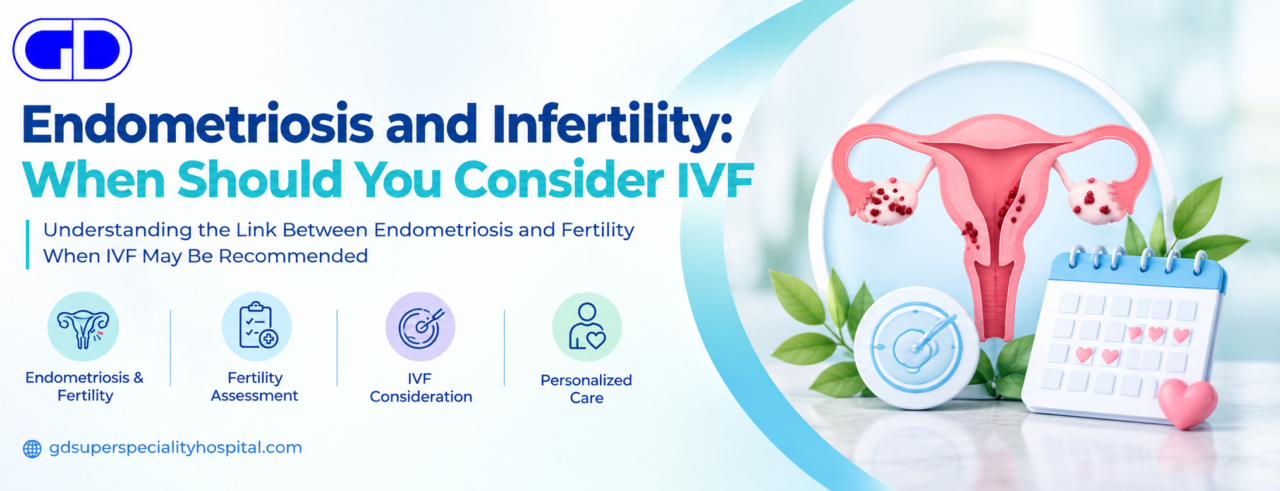
Endometriosis can reach far beyond painful periods. It develops when tissue similar to the uterine lining grows outside the uterus, where it can trigger inflammation, adhesions, cysts, and other changes within the pelvis. For some women, these effects can make conception more difficult.
For women struggling to become pregnant, Endometriosis and IVF can raise important questions. Yet an endometriosis diagnosis does not automatically mean IVF is the next step. Many women conceive naturally, while others may need fertility treatment depending on their age, reproductive history, ovarian reserve, fallopian tube health, and other individual factors.
Knowing when to seek specialist advice can prevent unnecessary delays and help women make informed decisions about their fertility journey.
How Can Endometriosis Affect Fertility?
Endometriosis may interfere with conception in several ways. The effect is not identical for every woman, so fertility assessment should be individualised.
Adhesions and Blocked Fallopian Tubes
Endometrial-like tissue can trigger inflammation and scar formation. These adhesions may distort the normal position of the ovaries or fallopian tubes.
If a fallopian tube becomes blocked or severely damaged, the egg and sperm may not meet easily. In such circumstances, IVF can be useful because fertilisation takes place outside the body and the resulting embryo is transferred directly into the uterus.
Pelvic Inflammation
Persistent inflammation can create an environment that is less favourable for reproductive function. It may affect interactions between eggs, sperm, and reproductive tissues.
Furthermore, inflammation can contribute to pain and adhesions, adding another layer of difficulty for some patients.
Endometriomas and Ovarian Reserve
Endometriosis can produce ovarian cysts known as endometriomas. These cysts, along with the disease itself and some surgical interventions, may affect ovarian reserve in certain women.
This is why tests such as Anti-Müllerian Hormone (AMH), antral follicle count, and ultrasound may be considered during fertility assessment. They help clinicians understand the available reproductive potential rather than relying only on symptoms.
When Should You Seek a Fertility Evaluation?
Timing matters, especially when endometriosis is already part of your medical history.
For women without known fertility risk factors, evaluation is commonly advised after 12 months of trying if under 35, or after six months if aged 35 or older. However, women with known or suspected endometriosis may benefit from earlier assessment, especially when endometriomas, previous pelvic surgery, tubal concerns, irregular periods, or reduced ovarian reserve are present.
However, these timeframes are not strict rules for everyone with endometriosis. Earlier assessment may be appropriate for women with severe symptoms, endometriomas, previous pelvic surgery, suspected blocked fallopian tubes, irregular periods, or reduced ovarian reserve. Women over 40 should generally seek prompt medical advice rather than waiting several months.
A fertility consultation can uncover where the difficulty may lie—whether with ovulation, the fallopian tubes, ovarian reserve, sperm health, or a combination of factors. Early evaluation can bring clarity and help shape a treatment plan suited to your reproductive goals.
Endometriosis and IVF: When Is It Considered?
Endometriosis and IVF may be considered when the condition is significantly affecting fertility or when other factors make natural conception less likely.
IVF may be discussed when endometriosis is affecting fertility, the fallopian tubes are blocked or severely damaged, ovarian reserve is a concern, significant male-factor infertility is present, or previous fertility treatment has not resulted in pregnancy. The recommended approach depends on the complete clinical picture, not on one test result alone.
The decision should not be based on the diagnosis alone. Instead, specialists consider the complete fertility picture.
After Other Treatments Have Not Worked
Some women may first receive medication, undergo appropriate surgery, or try IUI. If pregnancy does not occur after suitable treatment, IVF may become a reasonable next step.
IUI involves placing specially prepared sperm directly into the uterus around the time of ovulation. IVF is more complex because eggs are collected, fertilised in a laboratory, and embryos are subsequently transferred into the uterus.
Consequently, IVF can bypass some of the physical barriers associated with advanced pelvic disease.
When Tubal Damage Is Significant
Blocked or severely damaged fallopian tubes are an important reason to consider IVF. Even if ovulation is normal, natural fertilisation may be difficult when the sperm and egg cannot meet properly.
In this situation, IVF avoids dependence on the fallopian tubes for fertilisation.
When Age and Ovarian Reserve Become Important
Fertility naturally changes with age. Egg quantity and quality generally decline more rapidly as women move through their mid-30s and beyond.
For a woman with endometriosis, delaying evaluation may therefore have greater consequences if ovarian reserve is already reduced. A specialist may recommend moving more quickly toward assisted reproduction after reviewing age, AMH, ultrasound findings, previous treatment, and the length of time spent trying to conceive.
What Does Endometriosis Infertility Treatment Involve?
Fertility treatment needs to be tailored to each woman’s individual needs. Endometriosis infertility treatment depends on the severity of disease and the individual’s reproductive goals.
Laparoscopic Surgery
Laparoscopic surgery may be used to remove endometriosis lesions, adhesions, or certain endometriomas. In selected patients, this can help restore pelvic anatomy and may improve the possibility of natural conception.
However, surgery around the ovaries requires careful consideration. Repeated or extensive procedures can sometimes affect ovarian reserve. Therefore, surgery should be recommended only when its potential benefits outweigh its reproductive risks.
Fertility Medicines
Medicines may be used when ovulation problems are contributing to infertility. Hormonal treatment can control endometriosis symptoms, but hormonal suppression itself is not a method for achieving pregnancy while it is being used.
The treatment plan should therefore reflect whether the immediate goal is symptom control or conception.
IUI
IUI can be considered in selected patients, particularly when the tubes are open, and there are no major barriers to conception. Its suitability depends on age, ovarian reserve, sperm quality, disease severity, and previous treatment.
IUI may be considered in selected patients when at least one fallopian tube is open and there are no major barriers to conception. However, age, ovarian reserve, sperm quality, endometriosis severity, previous treatment, and the duration of infertility must be considered before deciding whether IUI is appropriate.
What Factors Influence the IVF Decision?
Endometriosis and IVF decisions involve more than the severity of pelvic pain. Some women have substantial pain but relatively preserved fertility, while others may have limited symptoms but significant reproductive problems.
A fertility specialist will usually consider:
- Age and reproductive history
- Duration of unsuccessful attempts to conceive
- Ovarian reserve and egg-related factors
- Fallopian tube condition
- Severity and location of endometriosis
- Presence of endometriomas
- Previous pelvic surgery
- Sperm count, movement, and morphology
- Previous IUI or other fertility treatment
- Any additional reproductive conditions
This broader assessment helps avoid a one-size-fits-all approach.
What Tests May Be Recommended?
A fertility evaluation may include several investigations.
An ultrasound can assess the uterus and ovaries and may identify endometriomas. Ovarian reserve testing can provide information about egg supply. Depending on the clinical situation, tubal evaluation may determine whether the fallopian tubes are open.
Male partners should also be evaluated. Semen analysis can identify problems involving sperm concentration, motility, or morphology.
This matters because infertility can involve female factors, male factors, both partners, or no clearly identifiable cause. Treating only one person without assessing the other can delay appropriate care.
How Can You Prepare for an IVF Consultation?
Before an appointment, make a simple record of your menstrual pattern, previous pregnancies, surgeries, fertility treatments, medications, and the length of time you have been trying to conceive.
Bring previous ultrasound reports, AMH results, operative notes, and other fertility investigations if available.
It is also useful to ask specific questions:
- Is my ovarian reserve adequate for my age?
- Are my fallopian tubes open?
- Would surgery help or potentially reduce ovarian reserve?
- Is IUI reasonable in my situation?
- Why would IVF be recommended now?
- What alternatives are available?
- How might my age affect the treatment timeline?
Clear questions can make a complex consultation easier to understand.
Finding the Right Fertility Specialist
Choosing experienced fertility care is particularly important when endometriosis is combined with infertility. A Fertility specialist near me can assess the condition from a reproductive perspective rather than focusing only on pain management.
For patients seeking Fertility specialist services in Mayiladuthurai, the priority should be access to appropriate diagnostic evaluation, evidence-based treatment planning, and coordinated care.
The right specialist should explain why a particular treatment is being suggested. They should also discuss alternatives, possible limitations, and the implications of delaying treatment.
Lifestyle and Fertility Support
Lifestyle choices cannot cure endometriosis, but general health can support fertility treatment and overall wellbeing.
Avoiding smoking and limiting excessive alcohol intake are sensible steps. Maintaining a healthy weight, getting adequate sleep, managing stress, and following a balanced diet may also support reproductive health.
However, lifestyle changes should complement medical care rather than replace fertility evaluation when conception has been delayed.
Why Timely Assessment Matters
Endometriosis and IVF should be discussed early enough to protect reproductive options, especially when age or ovarian reserve may be a concern.
Waiting does not always improve fertility. In some situations, the disease may continue to affect pelvic anatomy, while age-related changes in egg quality progress independently.
That does not mean every woman with endometriosis needs immediate IVF. Rather, timely assessment gives patients a clearer picture of their options.
IVF Treatment in Mayiladuthurai: What Should You Look For?
When considering IVF treatment in Mayiladuthurai, look beyond the procedure itself. Ask about diagnostic facilities, fertility counselling, embryology support, treatment monitoring, and how the clinic handles conditions such as endometriosis.
It is also worth understanding the complete treatment pathway before starting. IVF involves ovarian stimulation, monitoring, egg retrieval, fertilisation, embryo development, and embryo transfer. Some patients may be advised to consider additional techniques, such as ICSI, when significant male-factor infertility or a previous fertilisation problem is present. The decision should be made by the fertility team based on the individual circumstances.
A transparent discussion helps patients understand what is medically appropriate rather than choosing treatment based only on advertised success claims.
Endometriosis and IVF: A Personalised Decision
Endometriosis and IVF can be a suitable combination when endometriosis, age, tubal problems, reduced ovarian reserve, male-factor infertility, or unsuccessful previous treatments make natural conception less likely.
At the same time, an endometriosis diagnosis does not remove the possibility of natural pregnancy. The appropriate pathway may involve observation, surgery, medication, IUI, IVF, or a combination of approaches.
The key is to evaluate fertility early and make decisions based on the individual’s reproductive goals and clinical findings.
Expert Fertility Care with Compassion and Experience
At GD Super Speciality Hospital, patients receive personalised fertility care supported by experienced gynaecology and infertility specialists. Dr. Geetha Daniel, MBBS, DGO, brings expertise in fertility treatments, prenatal care, and women’s health, while Dr. G. Katherin Rajesh, DNB (OG), focuses on comprehensive, patient-centred care. If you are seeking a Fertility specialist in Mayiladuthurai, our team combines clinical expertise with compassionate guidance to help you understand your options and move forward with confidence.
End Note
If you have been trying to conceive and are concerned about endometriosis, seeking professional guidance can provide clarity. GD Super Speciality Hospital offers infertility evaluation and fertility care with diagnostic services, assisted reproductive options, and specialist support for individuals and couples. Consider scheduling a consultation to discuss your fertility history and understand which treatment pathway may be appropriate for you.
In conclusion, Endometriosis and IVF should be approached as an individual medical decision, not an automatic treatment choice. Early assessment, accurate diagnosis, and a carefully planned fertility strategy can help protect valuable reproductive opportunities.
Frequently Asked Questions
1. When should I consider IVF for endometriosis-related infertility?
IVF may be considered when endometriosis affects fertility, fallopian tubes are blocked, ovarian reserve is reduced, other fertility treatments have failed, or additional factors such as male infertility are present.
2. What fertility tests are recommended before IVF for endometriosis?
Evaluation may include ultrasound, ovarian reserve testing, tubal assessment, and semen analysis. These tests help identify the factors affecting conception and determine whether IVF or another treatment is appropriate.
3. How much does IVF treatment for endometriosis cost?
IVF costs vary depending on the treatment plan, medications, investigations, and additional procedures required. A fertility consultation can provide a personalised estimate after assessing your reproductive health and treatment needs.
4. Is IVF safe for women with endometriosis?
IVF can be an appropriate fertility option for women with endometriosis when clinically indicated. A fertility specialist should assess ovarian reserve, disease severity, previous surgery, and other factors before recommending treatment.
5. How is specialist fertility care different for women with endometriosis?
Endometriosis-related infertility may require more than routine fertility treatment. A specialist considers disease severity, ovarian reserve, tubal health, age, sperm factors, and previous treatments to create an individualised plan.
RAG Summaries
Endometriosis and Fertility: Key Facts
Endometriosis can affect fertility through pelvic inflammation, adhesions, endometriomas, tubal damage, and possible changes in ovarian reserve. However, a diagnosis does not automatically mean IVF is necessary. Some women conceive naturally, while others may need medication, surgery, IUI, or IVF. Fertility assessment should consider age, reproductive history, ovarian reserve, fallopian tube health, sperm quality, disease severity, and previous treatments. Early evaluation can help identify potential barriers and support a personalised treatment strategy without unnecessary delays.
IVF Considerations: Timing and Treatment
IVF may become appropriate when endometriosis significantly affects fertility, fallopian tubes are blocked or damaged, ovarian reserve is declining, male-factor infertility exists, or previous treatments have not resulted in pregnancy. Age also matters because fertility generally declines with advancing age. Women under 35 are commonly evaluated after 12 months of unsuccessful attempts, while those over 35 may benefit from assessment after six months. Earlier consultation can be appropriate with severe symptoms, endometriomas, previous pelvic surgery, or suspected reproductive problems.
Specialist Care and Informed Decisions
Choosing fertility care involves more than selecting an IVF procedure. Evaluation may include ultrasound, ovarian reserve testing, tubal assessment, and semen analysis. Patients should understand available options, treatment benefits, possible limitations, and the implications of delaying care. Lifestyle measures can support overall reproductive health but should not replace medical assessment. Experienced fertility specialists can coordinate diagnosis and treatment while providing compassionate guidance. GD Super Speciality Hospital offers fertility evaluation, assisted reproductive care, and specialist support for couples seeking informed treatment decisions.